Chat-based shopping is already how a lot of people make decisions. They describe what they need, ask follow-up questions, and narrow the options until something feels right. When ads show up inside that flow, eCommerce teams get more than a new placement. They get a new kind of intent signal.
The upside is real. So is the risk of spending money and learning nothing.
This is an operator's playbook for making that test accountable. The goal is not to be early. It is to set up tracking, reporting, and a reallocation model that lets a growth lead and a finance stakeholder agree on what success looks like, how to measure it, and when to move budget away from Google Shopping or Meta.
One thing to get straight before anything else, because it shapes every decision that follows: ChatGPT Ads does not give you a search terms report. More on that below, and it is not a limitation you can engineer around.
How to read the claims in this post
Advertising guides on this topic age badly. Most of what ranks today was written in February 2026 and describes a product that no longer exists. So every factual claim here carries a grade:
Confirmed stated by OpenAI on its own pages, quoted directly.
Observed seen in a live Ads Manager account on 8 September 2026 and screenshotted.
Reported named trade press, attributed.
Unverified vendor and agency estimates. Ranges only, never stated as fact.
Our own position, stated plainly so you can weigh the rest: we hold a verified OpenAI advertiser account and have walked the full campaign, feed, and measurement setup. We have not run spend. Everything marked Observed is configuration, not performance. Where we have no data, we say so rather than borrowing someone else's. Account identifiers in the screenshots below are replaced with a placeholder name.
What you are actually buying
Confirmed (OpenAI). A ChatGPT ad is a sponsored card that appears below the assistant's response. It carries an advertiser name, an "Ad" label, a headline, a short description, a thumbnail, and a link. It is ruled off from the answer above it.
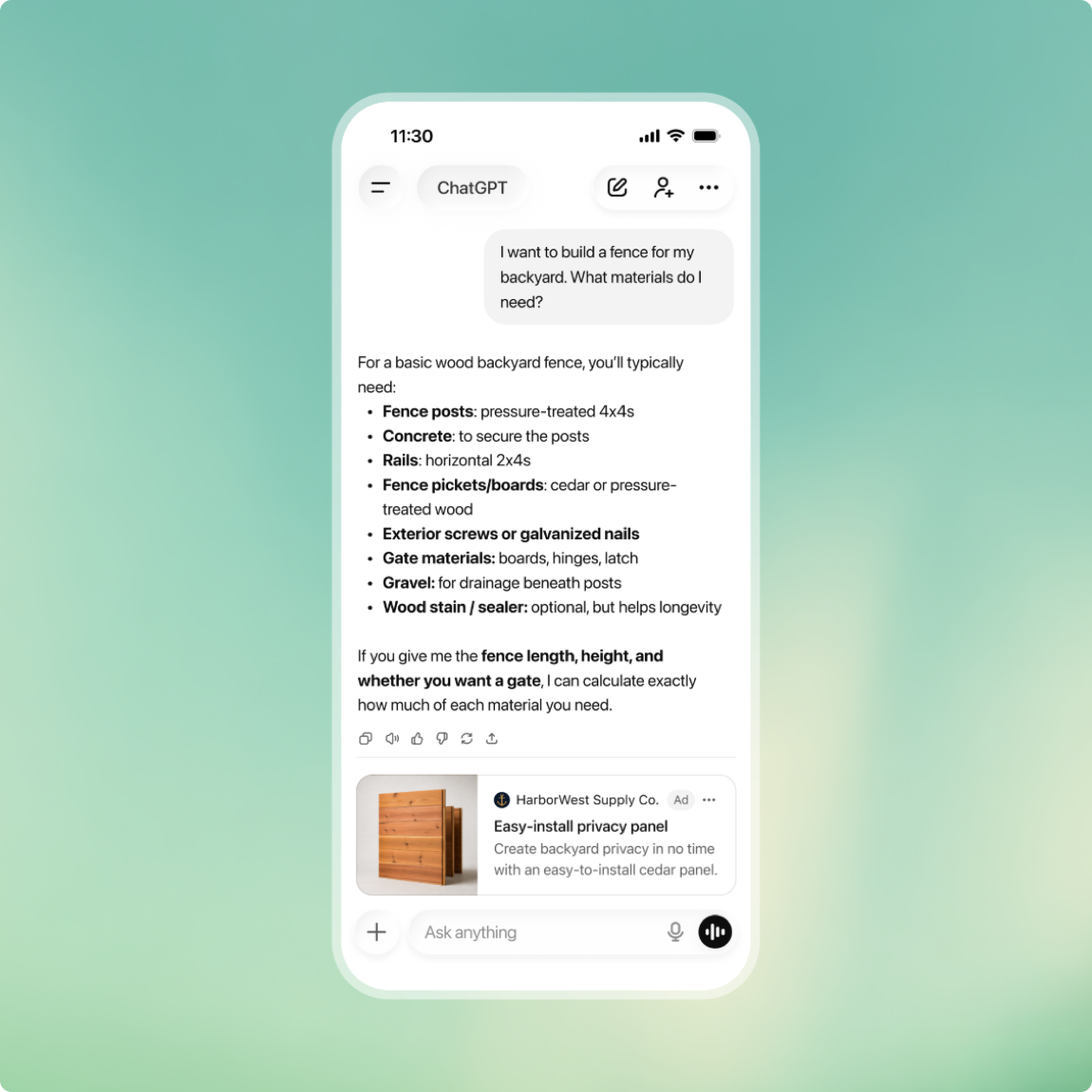
The anatomy of a ChatGPT ad: advertiser name, "Ad" label, headline, description, thumbnail, and a separator rule above it. Source: OpenAI.
Four things OpenAI states directly, all of which matter for how you plan:
- Ads run on Free and Go tiers only, to logged-in adult users. Plus, Pro, Business, Enterprise and Education are ad-free. Free users can also opt out of ads in exchange for fewer daily messages.
- Ads do not influence the answer. They are labeled sponsored and visually separated.
- Targeting uses the conversation topic, your past chats, and your past interactions with ads. This is worth reading twice, because a lot of early coverage claimed ChatGPT ads were purely contextual with no behavioral component. That was never accurate, and it is not what OpenAI describes.
- No ads near sensitive categories. Nothing for users known or predicted to be under 18, and nothing adjacent to health, mental health, or politics.
Confirmed (OpenAI), geography. Ads launched in the US on 9 February 2026, expanded to Canada, Australia and New Zealand from late March, and as of 11 August 2026 are live in the United Kingdom, Mexico, Brazil, Japan and South Korea. OpenAI says it is continuing to expand this year.
If you have been treating this as a US-only channel, that is out of date.
The report that does not exist
This is the section that should change your plan.
Observed. The reporting surface in Ads Manager is four metrics: Spend, Impressions, Clicks, CPC. Segmentation offers exactly three options: Device, Country, Platform.
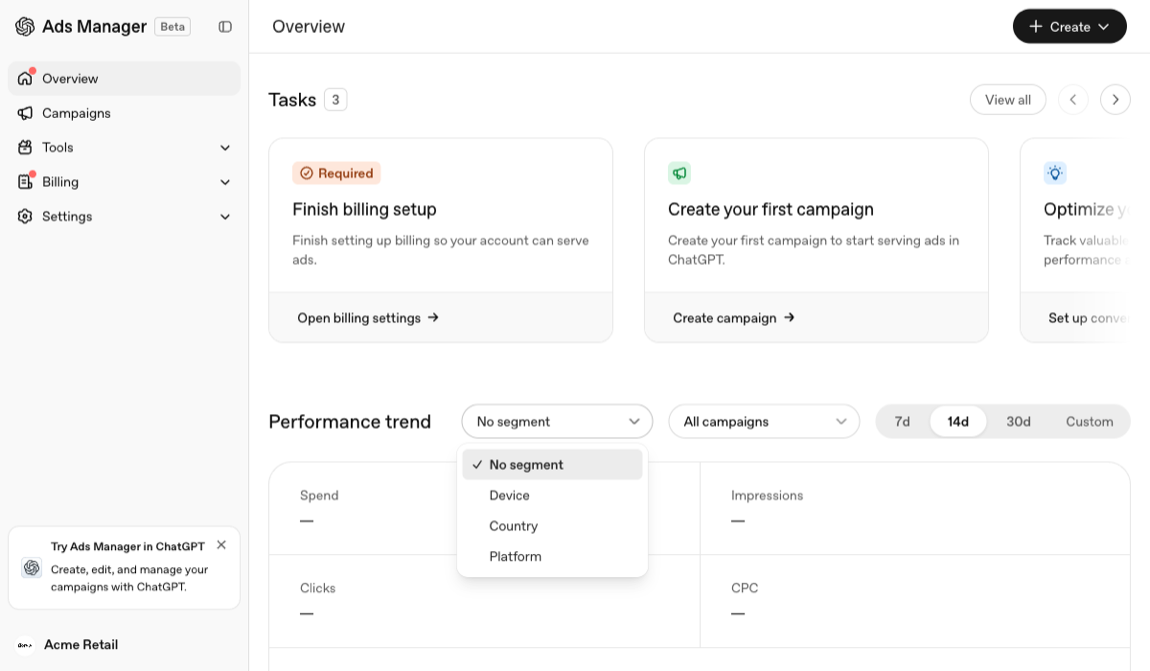
Every way you can slice ChatGPT Ads reporting, as of 8 September 2026. The metric tiles behind it are Spend, Impressions, Clicks and CPC.
There is no query report. No prompt themes, no intent categories, no search terms view, no equivalent of the Google Ads search terms report. Not "not yet." Not "gated behind spend."
Confirmed (OpenAI) explains why, and it is a design decision rather than a roadmap gap:
"Advertisers receive aggregated performance insights that help them understand campaign impact, without access to individual conversations."
And elsewhere:
"Advertisers do not have access to your chats, chat history, memories, or personal details. Advertisers only receive aggregate information about how their ads perform such as number of views or clicks."
Three consequences for how you run this channel:
- You cannot optimize toward query-level intent, because you will never see the queries. The optimization loop you know from Shopping does not port over.
- Your creative and feed hypotheses cannot be validated inside the platform. They have to be validated by what happens on your own site.
- Almost all of your measurement has to live on your side of the click. This is not a nice-to-have. It is the only place signal exists.
That last point is why the rest of this post is weighted toward instrumentation rather than campaign management. In a channel with no query data and one ad slot per response, the platform gives you very few levers. Your site gives you all of them.
Three ways to buy, and what the console actually offers
Confirmed (OpenAI). There are three routes:
- Agency partners: Dentsu, Omnicom, Publicis, WPP.
- Technology partners: Adobe, Criteo, Kargo, Pacvue, StackAdapt.
- Self-serve Ads Manager, in beta since 5 May 2026, open to US businesses of all sizes.
Worth noting for anyone planning to buy through a partner: OpenAI states that partners "help support campaign budgeting, bidding and advertising creative, while OpenAI's ads system controls all delivery decisions." You are not buying inventory control. You are buying help with the parts around it.
What the buying surface looks like inside
Observed. Three campaign objectives, and that is the whole list: Reach, Clicks, Conversions.
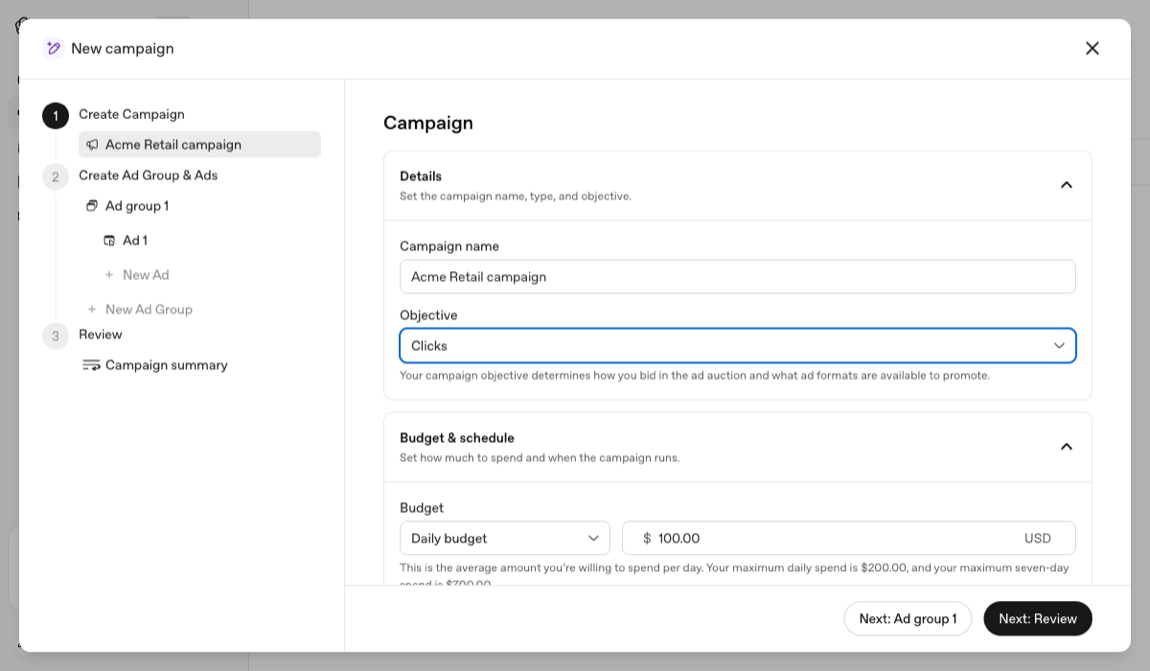
The complete set of ChatGPT Ads campaign objectives. Note the budget text underneath: a daily budget is an average, not a ceiling.
This is a useful correction to the guides that present CPM, CPC, CPA and oCPC as things you choose. You choose an objective; those are the billing and bidding models underneath it. Under the Clicks objective there are two bid strategies: Maximize results (recommended by default) and Maximum CPC. Conversion bidding sits under the Conversions objective, not as a universal toggle.
Confirmed (OpenAI): CPM was the only option in the first phase of the pilot. CPC bidding arrived on 5 May 2026, and OpenAI says both continue to be supported. Reported: conversion-optimised bidding followed in early June, and oCPC entered beta for product feed campaigns by early August.
The budget mechanic nobody documents
Observed
A daily budget in ChatGPT Ads is an average, not a ceiling. The interface states it plainly: your maximum daily spend is 2× your daily budget, and your maximum seven-day spend is 7×.
Set a $100 daily budget and you have authorised up to $200 in a single day and $700 across a week. If you have promised finance a hard cap, the number you set is not the number to promise.
Observed, the rest of the setup surface:
- No minimum spend appears anywhere in the flow. (Reported: the pilot's $200,000 minimum, later cut to $50,000, was removed when self-serve opened. Vendor posts describing a "practical $5,000/month floor" are describing their own recommendation, not OpenAI policy.)
- Billing must be set up before anything serves. The account gates on this.
- Targeting is locations to include, locations to exclude, and eligible platforms, which break out as Android app, Android web, Desktop web, iOS app and iOS web. App versus web is selectable, which matters if you are app-first.
- Context hints are an ad-group setting under "Ad delivery & tracking," not a campaign-level targeting control.
- Ads Manager is still badged Beta seven months after launch.
Feed readiness: reuse the data, not the plumbing
If you already run Shopping and catalog ads you have the raw ingredients: a catalog, images, prices, availability, attributes. The trap is assuming that passing validation means selling in a conversation.
How you actually connect a catalog
Observed. Three ingestion paths, and most guides describe only the middle one:
- Upload CSV or TXT. Best for getting started or occasional manual updates.
- Hosted URL. A catalog available at an HTTPS address.
- SFTP connection. Automated server-to-server, for technical teams.
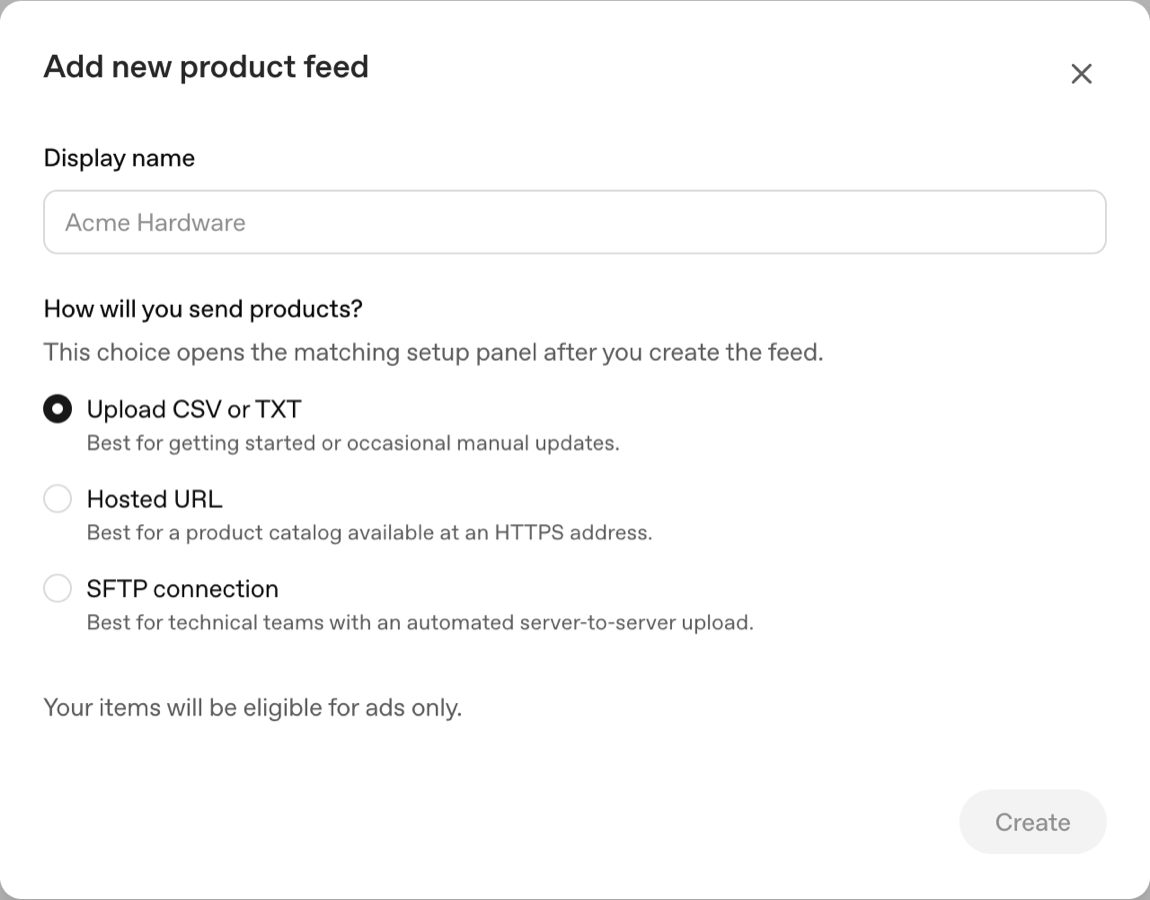
Three ways to send a catalog. Note the line at the bottom: feed items are eligible for ads only.
Formats are CSV or TXT. This is not a Merchant Center style XML integration, so "just reuse your Google Shopping feed" holds for the data but not the plumbing. Budget engineering time accordingly.
The clarification almost every article gets wrong
Observed
The feed creation dialog states: "Your items will be eligible for ads only."
Uploading a catalog to ChatGPT Ads does not place your products in ChatGPT's organic shopping results. These are two different surfaces. A great many posts conflate them, and teams have planned work on the assumption that a feed buys organic presence. It does not.
If you want to appear in the answer rather than beneath it, that is a content and machine-readability problem, not an ads problem.
What to fix in the feed
Conversational shopping exposes different weaknesses than keyword shopping, because constraints are more specific and more varied. A shopper asks for a carry-on that fits under the seat on budget airlines, a sofa fabric that survives cats, a skincare routine that will not pill under sunscreen.
If your feed does not encode the relevant attributes, dimensions, materials, compatibility, care instructions, the assistant has less to work with. You may still get traffic, but it will be less qualified, and the bounce will look like a creative problem when it is really a data problem.
Prioritise what a good store associate would ask about:
- Start with your top revenue categories.
- Identify the top constraint types: size and fit, compatibility, materials, shipping speed, warranty and returns, use case, what is included.
- Represent those constraints in structured attributes where you can, and in clean unambiguous titles and descriptions where you cannot.
Some eCommerce teams use Storyly to build interactive canvases inside their app or site experience, replacing static areas with interactive content that can surface more categories or campaigns without redesigning the whole page. That helps you react to new demand patterns quickly. It does not fix feed data, and it is worth being honest about the difference.
The default that rewrites your ad copy
Observed, and we have found no coverage of this anywhere.
In the campaign review step there is a setting called Text customization. It ships on. The interface describes it like this:
"AI automatically generates personalized and translated versions of your ad's headlines and descriptions, which may be shown without your individual review or approval."
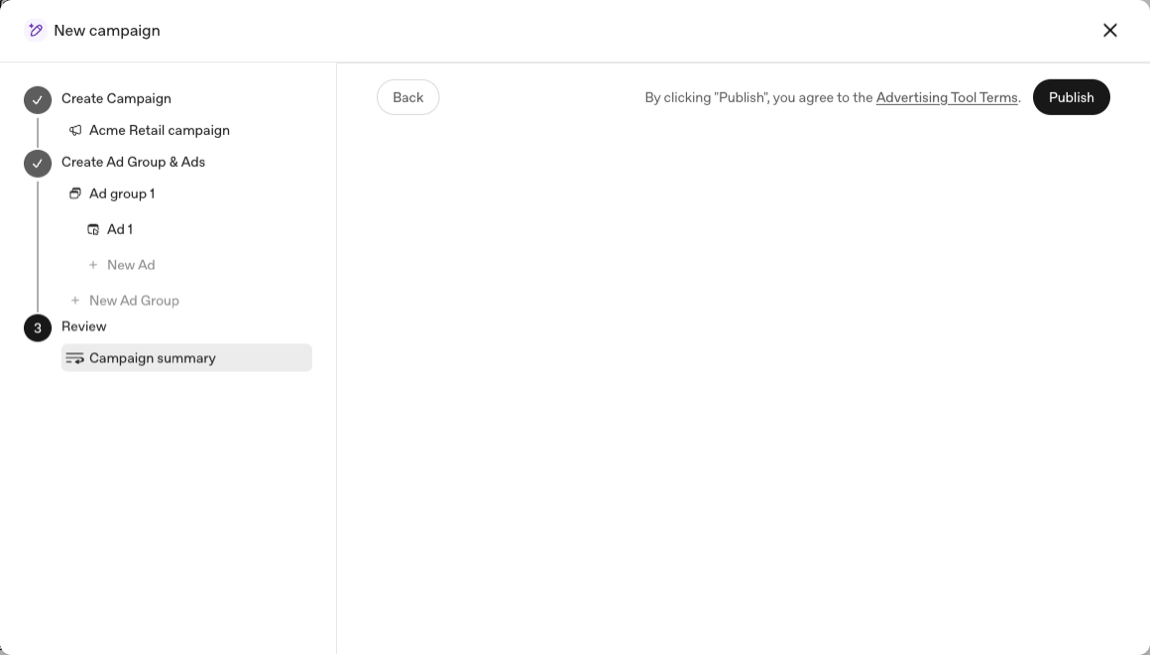
On by default. Every new campaign ships with this enabled.
Read the second half of that sentence again. Your headlines and descriptions can be rewritten and translated by a model, then served, without you seeing the output.
For a broad catalogue retailer chasing reach, this is a reasonable default and probably a helpful one. For anyone in a regulated category, anyone whose copy carries substantiated claims, or anyone running a tightly controlled brand voice, it is the most consequential switch in the account. Legal review of your submitted copy does not cover copy you never wrote.
Decide deliberately. Do not discover it after launch.
The measurement-first playbook
Given there is no query report, your instrumentation is not a supporting task. It is the entire optimization loop.
Treat the first two weeks as an instrumentation sprint rather than a scaling sprint. The goal is to remove ambiguity from four questions: what traffic is this, what does it do on site, how does it overlap with Shopping and Meta, and what would you need to believe to move budget.
What the platform gives you
Observed. Conversion setup is a four-step chain, and most guides skip straight to "install the pixel":
- Create a data source
- Create a conversion event
- Implement and log the event
- Link the event to a campaign
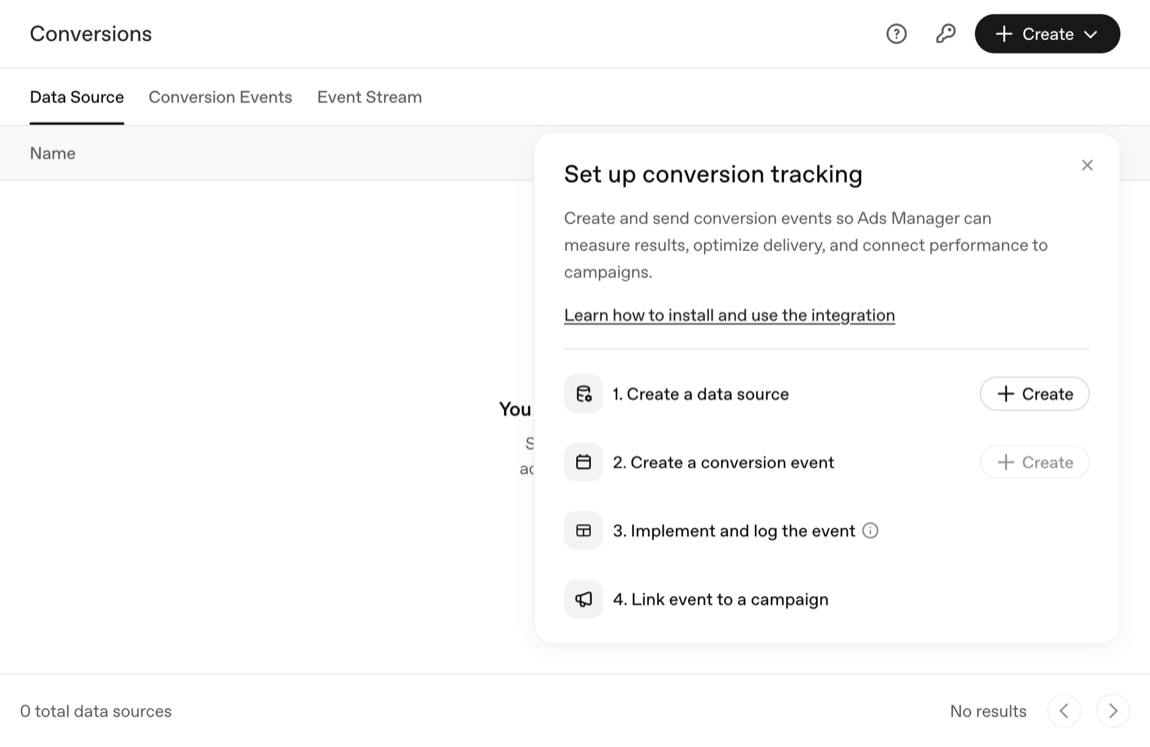
The four-step chain, plus Conversions API keys and the undocumented EQS column.
Separately there are Conversions API keys. The events table also carries an EQS column, an event quality score, which is undocumented in any coverage we could find. Worth watching even though OpenAI has not explained it.
Reported (Search Engine Roundtable, 7 August 2026): ChatGPT Ads supports dynamic URL parameters, with macros including {campaign_id}, {ad_group_id}, {ad_id} and {ad_account_id} populated at delivery. That is your deterministic join key, and it is the closest thing to a click identifier the platform offers. Triple Whale and Hightouch now support ChatGPT Ads measurement and conversion APIs, which may save you build time.
The change that was switched on for you
Reported, and Observed in product. Automatic advanced matching became the default for new web pixels, and on 17 August 2026 OpenAI enabled it for existing web pixels too, opt-out only.
The in-product description explains why nobody noticed:
"Automatic advanced matching detects supported customer information from your website, normalizes and securely hashes it in the browser, and requires no Pixel implementation changes."
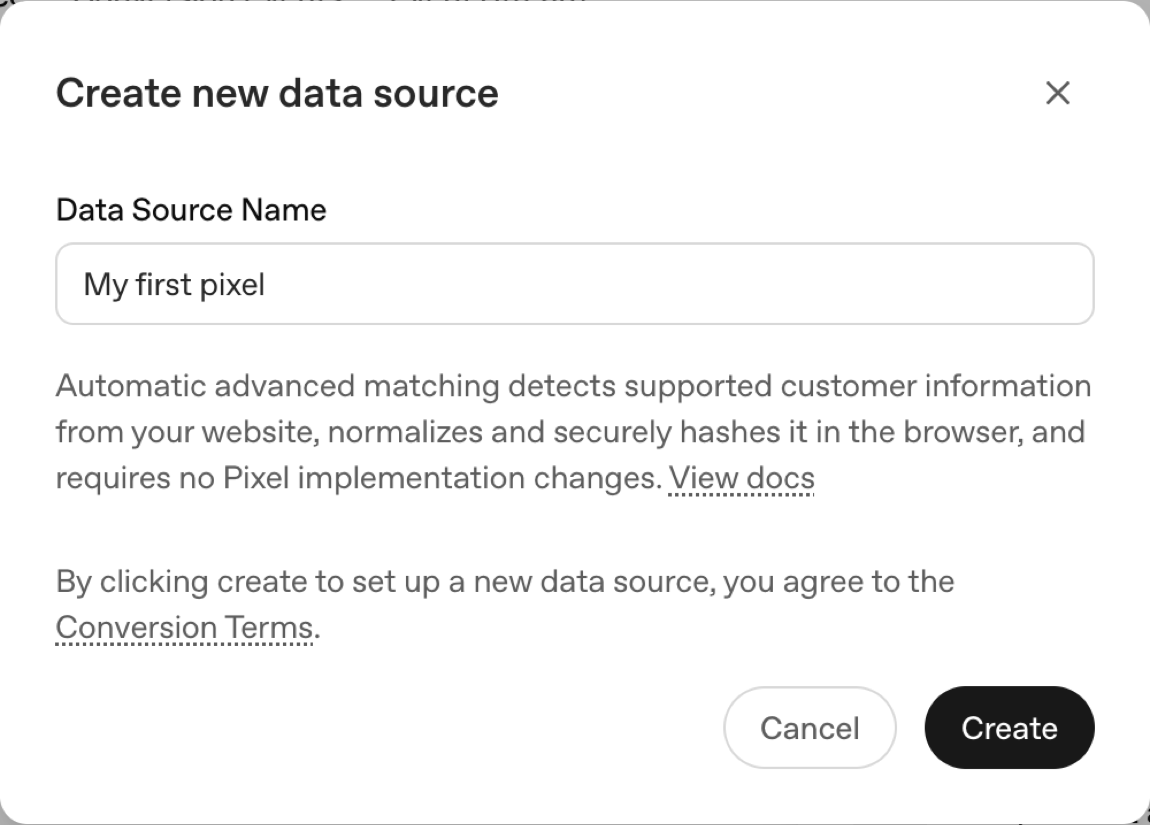
Automatic advanced matching, described in the product itself.
Go and check this
Nothing broke, so nothing prompted anyone to look. If you set up a pixel before August and have not revisited it, check what it is now sending, and whether that matches what your privacy notice says you collect. This is a five minute job with a legal dimension.
Tracking stack: UTMs, server-side events, and a truth backstop
Three layers, because none of them is sufficient alone:
- Deterministic tracking. UTMs plus the dynamic URL macros above, to identify sessions and orders.
- Server-side events. Conversational traffic may break referrers, open in in-app browsers, or pass through redirects. If your purchase event loses source and medium, you will spend meetings debating attribution philosophy instead of improving performance.
- A truth backstop. A post-purchase survey to catch influence that attribution misses.
Keep UTMs boring and consistent. Simple enough for finance to read in a spreadsheet, strict enough to avoid ten variants of "chatgpt" in your reports. One caution specific to this channel: do not plan to dump prompt text into utm_term. You will not have prompts, and if you somehow did, that is exactly the kind of data you should not be moving into your analytics stack.
The post-purchase survey matters more here than in a normal channel, precisely because the platform tells you so little. Design it for recall rather than flattery:
- Q1, single select: "How did you first hear about us for this purchase?" with AI assistants as one option category.
- Q2, optional: "If an AI assistant helped, which one, and what did you ask?"
Q2 is the closest thing you will get to a query report, and it comes from your customers rather than the platform. It will not scale, and it will be biased by recall. It is still the only view of the language people used, which makes it useful for feed attributes and creative both.
Weekly reporting
Report three views side by side, with definitions that stay stable:
- Platform-reported: Spend, Impressions, Clicks, CPC. That is all there is, so do not build a template with fields the platform cannot fill.
- Analytics-reported: your GA or warehouse view via UTMs and last non-direct rules.
- Blended business outcomes: orders, margin, return rate, new versus returning, for the cohort that touched the channel.
Then a short written interpretation: what changed, what you did, what you will do next. An investment memo, not a victory lap.
The benchmarks you will be quoted, and which ones survive
If you are building a business case, you will meet the same handful of numbers. They are not equally sound, and one of them is being widely misused.
On click-through rate. Similarweb's "Advertising in AI" analysis, reported 5 May 2026, put overall ChatGPT ads CTR at 0.68%, top quartile at 1%, best brands at 1.57%, with a peak of 5.4%. Similarweb's own comparison points were display at around 0.35% and podcast at 0.5 to 1%, against which ChatGPT ads look strong.
Two caveats worth carrying into any deck you build. First, the "versus Google's 6.66%" comparison you will see everywhere is not Similarweb's; vendor blogs bolted it on. Second, Similarweb has not disclosed its sample or methodology, so attribute and date the figure rather than treating it as settled.
The structural point matters more than the number: ChatGPT shows one ad per relevant response, and it appears after the user already has their answer. A lower CTR than a scrollable feed of ads is a property of that placement, not a verdict on it.
The number to stop using
A widely repeated stat claims ChatGPT-referred eCommerce traffic converts at 15.9% against 1.76% for Google organic. It traces to a Seer Interactive case study covering one client, one site, from October 2024 to April 2025, with roughly 11,000 AI sessions against 14 million Google organic sessions. AI traffic was 0.07% of organic traffic. Seer says plainly it may not be representative.
It is not identified as an eCommerce client, it is a single site, and the measurement window closed ten months before ChatGPT ads existed. It says nothing about ad performance. If it appears in your business case, take it out.
The number to use instead. Visibility Labs analysed 94 eCommerce brands across 12 months of GA4 data (January to December 2025), excluding homepage and blog traffic. ChatGPT referral traffic converted at 1.81% against 1.39% for non-branded organic search, the "31% higher" figure you may have seen. Sample: 9.46 million non-branded organic sessions against 135,000 ChatGPT sessions.
Say the quiet part when you present it: 31% relative is 0.42 percentage points absolute. Real, worth having, and nothing like the order of magnitude the 15.9% implies.
The caveat that applies to all of it. Every study above measures organic ChatGPT referral traffic, not ads. There is still no credible public dataset on ChatGPT ad conversion performance for eCommerce. Anyone presenting one to you should be asked where it came from.
The budget reallocation model
A new channel becomes real when you can answer the budget question without hand-waving. "Should we move budget from Google Shopping?" is a model decision with explicit assumptions: marginal returns, overlap, operational cost, and risk.
Start with channel roles. Shopping captures explicit product intent. Meta can create demand and retarget it. ChatGPT ads sit closer to assisted intent, where users are expressing constraints and the assistant is shaping a shortlist. That overlaps with Shopping, but it can also intercept earlier.
Three scenarios:
- Parallel test, no reallocation. Fund from incremental test budget. Safest for learning, weakest for proving incrementality.
- Substitution test, controlled reallocation. Reduce Shopping or Meta by a small explicit amount and move exactly that to ChatGPT ads. Forces the incrementality question.
- Guardrailed scale. Increase only when it clears pre-set thresholds on both performance and operational stability, meaning tracking completeness, feed health and support load.
Express the model in margin terms rather than ROAS. Finance cares about contribution after variable costs, not revenue credited to a channel.
Decision logic that holds up in a real budget meeting:
- Shift from Shopping when ChatGPT ads bring incremental customers and Shopping is already at diminishing marginal returns.
- Do not shift from Shopping when Shopping is still efficiently capturing high-intent demand and your ChatGPT ads mostly overlap with branded or already-decided users.
- Shift from Meta prospecting only if ChatGPT ads reliably produce new-to-brand customers at acceptable payback and you can sustain creative velocity.
Two constraints specific to this channel that belong in the model:
- The 2× daily and 7× weekly spend caps mean your downside in a substitution test is larger than the daily budget suggests. Size the test against the cap, not the budget.
- You cannot prune by query. In Shopping, a bad test can be salvaged mid-flight by cutting search terms. Here you have Device, Country and Platform. Your only real controls are pausing, changing the objective, and changing the creative. Assume less mid-flight steering than you are used to.
On incrementality, you are not proving causal lift with rigour in month one. You are reducing the risk of fooling yourself. Geo or time-based holdouts and budget substitution tests both work. The important part is pre-commitment: write down what counts as incremental enough before you see results, or every outcome becomes a post-hoc narrative.
Finally, price in the cost of being wrong. If attribution is noisy you can cut Shopping, which is usually a demand-capture engine, and create a revenue dip that takes weeks to recover. That is why the substitution test should be small, time-boxed, and pre-registered with finance.
In short
Test when you can measure it, pause when you cannot.
This channel gives you four metrics, three segments, and no query data. That is not a reason to skip it. Adoption is real and the intent quality is genuinely different. But it does mean the platform will not tell you why anything worked, so if you cannot connect spend to on-site behaviour and orders, plus at least one guardrail like returns or support load, you are not running a growth test. You are buying anecdotes.
Get the audit trail in place. Check what your pixel started sending in August. Decide about text customization before launch, not after. Run something small and pre-registered. Then decide whether ChatGPT ads deserve a seat next to Shopping and Meta.