
The World Cup has just started.
A projected 6 billion viewers worldwide, 48 national teams, and according to Numerator's latest survey, 89% of people who plan to watch also plan to buy something. In North America alone, that spending is estimated at $7.5 billion.
Brands already know this. Which is why the media spend around this tournament will be enormous. Search ads, social campaigns, influencer deals, out-of-home activations, every channel that can carry a World Cup message will carry one. Brands will spend heavily to get fans into their apps and onto their sites. The traffic will arrive.
And then most of them will run a World Cup banner and call it a campaign.
That is the gap. The traffic problem gets solved with budget. The in-app experience problem mostly goes unnoticed. Fans arrive emotionally primed, mid-tournament, mid-match, mid-decision, and find the same static grid they would have found in February. The moment passes. The purchase does not happen.
The tvelve ideas below are about closing that gap. Each one is an in-app campaign you can build right now using Storyly, without a broadcast budget and without a development sprint. Just the app you already have, and the content formats your customers already know how to use and love.
IDEA 1: Make Your Homepage Work as Hard as the Tournament Does
.png)
Your homepage has a prime real estate space that every user sees the moment they open your app. During a global tournament, leaving a static banner in that slot is the equivalent of setting up a tent at the World Cup final and not selling anything.
The smarter play is to manage that slot dynamically, and that is exactly what Storyly's Placement capability lets you do.
You integrate it once and after that, your marketing team controls what goes in that slot from the Storyly dashboard. You can swap between a Story Bar and a Banner, change the content, launch a new campaign, and pull it down again, all without touching the app code. It is the difference between a campaign that adapts to the moment and one that goes stale by matchday three.
Take a food delivery app as an example, which is arguably the category that benefits most from the World Cup calendar. During the week, when fans are browsing and planning, that homepage slot runs a Story Bar. Different campaigns on Monday, a "fan favourites this week" collection on Wednesday, a mini quiz on Thursday. Content that drives discovery and keeps the app worth opening even on non-match days.
Then Thursday evening comes around. The Story bar steps aside and a Banner takes the slot, front and center with a match-day bundle, a "30-minute delivery before kickoff" message, a limited offer that expires at final whistle. Same placement in the app. Completely different experience. Switched from the dashboard in minutes.
It is a new way to think about your most valuable screen real estate during the highest-traffic sporting event of the decade.
Best for: food delivery, grocery, QSR, convenience retail
IDEA 2: A World Cup Trivia Quiz That Earns the Discount
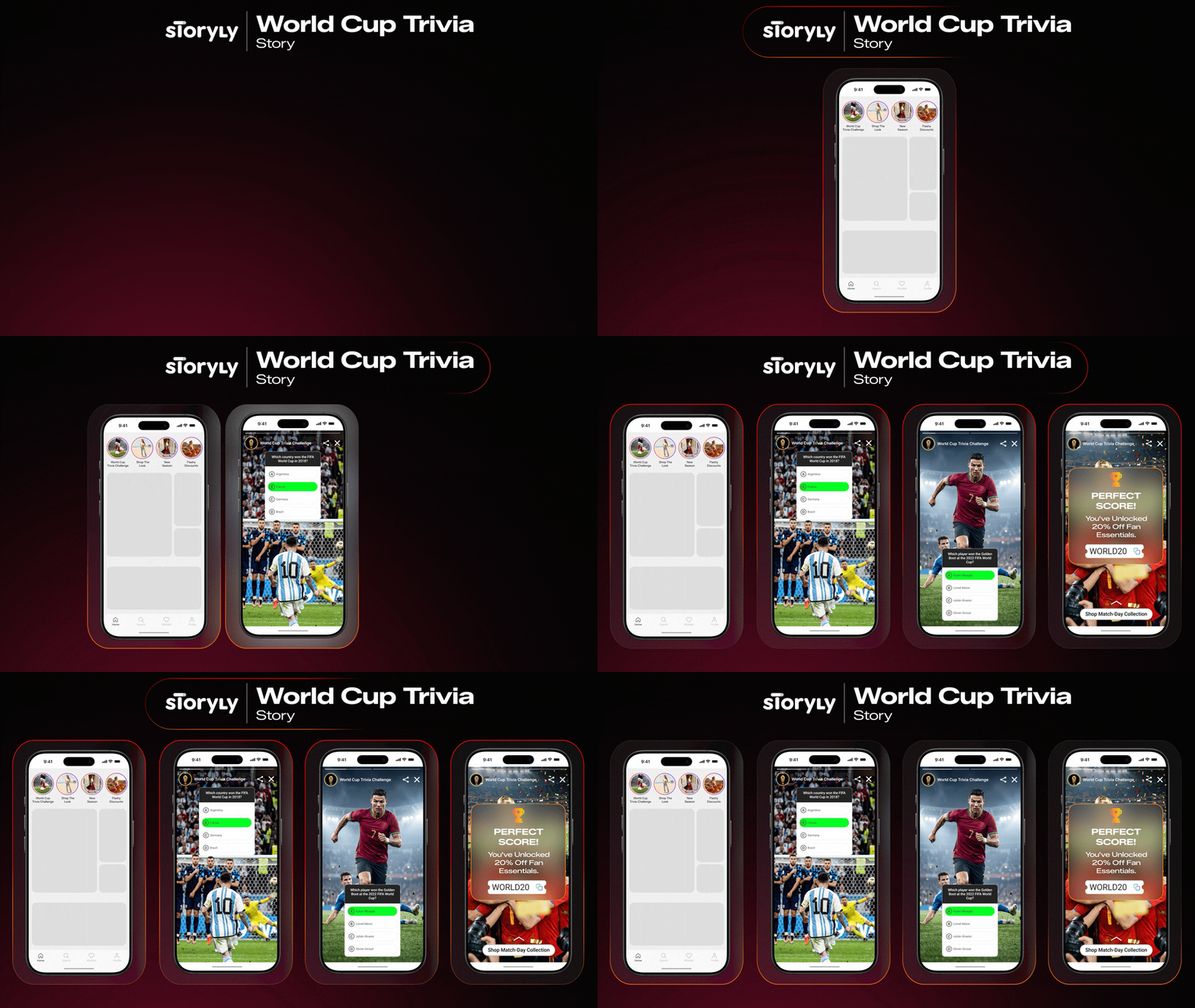
The World Cup is a long summer period of material. "Which edition of the FIFA World Cup is this?" "Which team won in 2018?" "How many goals did Ronaldo score at his first World Cup?" There is a new question for every matchday, and every question is a reason for a fan to open your app before the match, engage with your content, and leave with something worth using.
Use Storyly's interactive stickers to create a fun quiz and reward winners with a promo code, copyable directly from a promo code sticker inside the experience. Users who got it wrong see a different story, a warm "nice try" with an invitation to come back tomorrow for another shot. The trivia creates the session. The reward closes it. Refresh the question with each matchday. Five weeks of the tournament means five weeks of daily reasons to open the app.
BetBoom runs quiz-driven campaigns for sports events using this exact interactive format and records 58% quiz response rates from their users.
Best for: sportswear, fashion, grocery, food & beverage, any eCommerce app with an active promotional calendar, sports & betting
IDEA 3: Beauty Has Been Waiting for a Sports Moment. This Is It.
Most beauty brands do not see themselves in the World Cup. There are no jerseys to sell, no kits to feature, no stadium context that obviously maps to mascara or lip liner. That blind spot is exactly the opening.
National team colours are some of the most emotionally loaded palettes in the world. These are not just flag colours, they are identity colours, worn by hundreds of millions of fans who would put them on their face for a match if someone showed them how. That is a content territory that is almost entirely unclaimed in the beauty category.
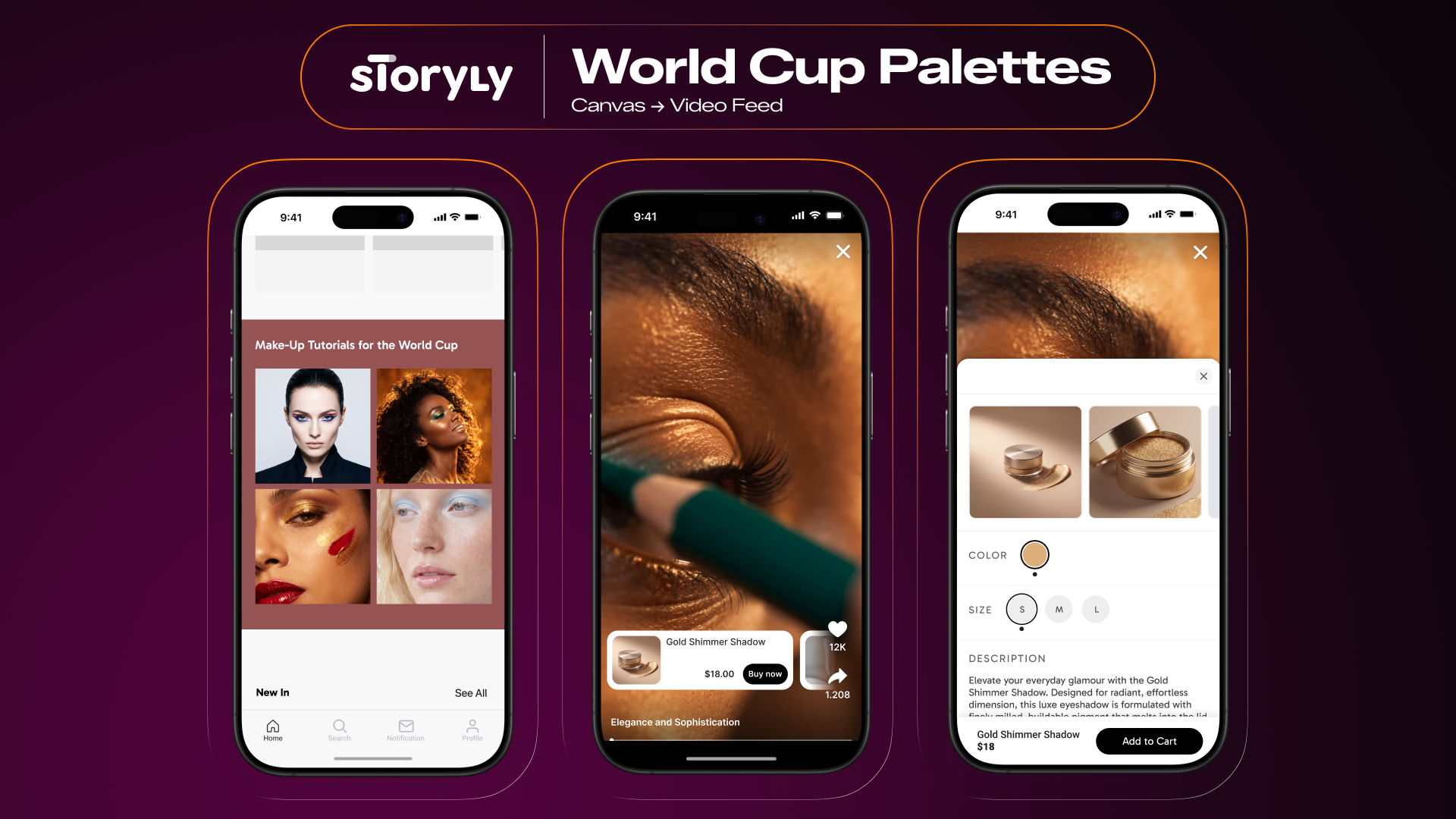
You can create a Video Feed organized by national team palette. Each video is shot in creator style, the kind of content you would produce for your brand's own social channels and can import directly into the feed from there. Every product visible in the look is tagged and shoppable within the frame. A fan who wants to wear the look to a watch party finds the exact products and adds to cart without leaving the video.
Sephora used Storyly and built a solution to a version of this problem. They created a dedicated page inside their app called the Beautyfeed, a full destination page. The top placement ran a Story bar for promotions and below it, a Video Feed showcased longer-form content like tutorials, product spotlights, and recommendations from beauty advisors and creators. The Story bar created the hook. The Video Feed created the depth.
It is a content library. The in-app experience and the social calendar feed each other.
Best for: beauty, cosmetics, skincare
IDEA 4: Turn Your Brand Video Content Into a Shoppable Match-Day Feed
Every major match creates a wave of video content. Kit reveals, styling edits, watch-party setups, goal reaction cuts, the volume during a World Cup tournament is unlike anything else in the calendar. Most of that energy stays on social platforms. Your app gets none of it.
Storyly's Video Feed gives you a way to bring video content into your app as a native, TikTok-style vertical scroll experience. You can import content directly from your brand's own Instagram or TikTok account, or upload videos from other sources, and surface them inside the app without sending shoppers back out to a platform that will absorb them for the next 45 minutes.
The content itself becomes shoppable. Each video in the feed supports product tags, CTAs, and a swipe-up product catalog that can be tailored to the video's subject. A video featuring Argentina matchday styling has a "Shop Argentina" CTA that opens a curated product sheet. The kit, the training jacket, the accessories. The fan watches a real piece of content about a team they care about, taps through, and lands directly on the products that make sense for that moment.
This matters because product photos and editorial images do a limited job while a video of someone wearing it is doing persuasion work that a PDP image cannot. It is content now working inside your app instead of keeping them on someone else's.
Each video becomes its own campaign touchpoint, and the feed as a whole becomes a destination worth returning to throughout the tournament.
Best for: sportswear, fashion, food delivery, grocery, any brand that produces social video content around the tournament
IDEA 5: Turn Your Tournament Best-Sellers Into a Fan Favorites Experience
Brands investing in the World Cup do not just run ads. They build for it. Dedicated product collections, team-tagged catalogs… The kits selling out. The accessories moving fastest. The items that fans of each nation are gravitating toward.
That data usually sits in an analytics report. Swipe Cards give it a front-door in the app.
Instead of asking fans to search a World Cup collection and hope they find what they want, you build a curated stack of the best-selling tournament items for the teams your audience supports. Swipe right on what you want. Swipe left on what is not for you.
A grid is a library. A Swipe Card stack of best-sellers is more like a conversation like “here are the ten items your team's fans are buying right now, which ones are yours?” It is fan entertainment and product discovery running on the same mechanic. The swipe gesture makes it feel like a game. The zero-party data it generates, which team, which products they chose, which ones they skipped, is the output.
Best for: sportswear, fashion, accessories, any retailer with team-tagged product collections
IDEA 6: The Countdown That Hooks Fans Before They Even Tap
Most campaign content only works once a user is already inside the experience. The more interesting setup for match-day is to create urgency before the fan taps anything at all.
With Storyly you can design a Story Group so that a countdown badge is visible directly on the Story Group ring, on the home screen, without the user opening it. A fan scrolls past the story bar and sees "2h 14m to kickoff" sitting right on your match-day group.. That’s what we call a great way to build FOMO.
For a sporting goods retailer or a fashion app running World Cup content, the setup is straightforward. You create a dedicated Story Group for each matchday. The badge on the outside counts down to that moment. When the fan taps in, they find the match-day product selection. The kit, the training layer, the accessories. Everything tagged and shoppable without leaving the experience.
Idealo used a countdown-driven approach for their Black Friday campaign, building Stories around time-pressure moments that let shoppers add to cart directly within the experience. The same logic carries into the World Cup.
Best for: sportswear, fashion, grocery, food delivery, electronics
IDEA 7: Match-Day Editorial Stories That Go Beyond the Jersey
Here is the thing about the competitions. Very few brands carry products for all of the nations competing. Most eCommerce apps have two or three team kits at most, maybe a few licensed accessories, and then a long tail of nothing. If your World Cup content strategy starts and ends with "show them the shirt," you have maybe five minutes of relevant experience before fans move on.
The more interesting angle is cultural. A World Cup match is not just 90 minutes of football. It is a viewing occasion, and viewing occasions have a full product picture around them.
A homeware brand publishing "How Brazil fans set up the perfect match night" does not need a single Brazil kit in stock. It needs a sofa throw in the right colours, a serving bowl for snacks, and the right glasses for the right drinks. Or a food and grocery app covering the Argentina vs. France final does not need jerseys. It needs the recipes, the ingredients, and the hosting kit.
With Storyly's Stories, every item in the story groups of your app is tagged directly to the product page. A fan taps the throw, the glassware, the jacket, and goes straight to the PDP without leaving the story. That is the difference between building a campaign as content and building a campaign as commerce.
You can pre-build Story Groups for upcoming fixtures and schedule them with start and end dates directly in the dashboard. No manual intervention is needed when multiple matches are running simultaneously.
Coppel, one of Mexico's largest department store chains, used shoppable stories across fashion, electronics, and home categories during seasonal campaigns and saw nearly 10% of home sales in the app attributed to stories during those periods. And the World Cup is the same engine running a different creative brief. The tournament has a global audience watching from living rooms, kitchens, and terraces. Start building the content now.
Best for: fashion, homeware, grocery, food delivery, sporting goods, electronics, any multi-category retailer
IDEA 8: Use the Tournament to Build a Wishlist Before Fans Are Ready to Buy
The World Cup is a long purchase consideration window. A fan who opens your app before kickoff on matchday three is not necessarily ready to buy yet. They are browsing, getting excited, building a mental shortlist. The gap between "I want that" and "I am buying that" is exactly where wishlist intent lives, and the tournament gives you a long runway to capture it.
Storyly's shoppable stories and swipe cards widgets support wishlist actions directly within the experience. You build the experience from the start. A Story group of the most-talked-about products for this tournament. Fans browse, tap, save. Then, as the tournament progresses, your analytics show you which products have accumulated the most wishlist additions across your user base. Those are your highest-intent items.
The wishlist data tells you what to show. The match calendar tells you when.
Decathlon used Story-based product discovery and cart reminders as part of their ongoing engagement approach, achieving 31% CTR and a 1% contribution to turnover from stories. The wishlist mechanic works on the same principle. Get the product in front of the fan at a moment of interest, reduce the friction to save it, and close the gap between intent and purchase when the emotional context is right.
Best for: sportswear, fashion, grocery, multi-category retailers with a clear match-day product selection
IDEA 9: The World Cup Creates Rich Behavioral Signal. Use Them.
Most World Cup marketing treats the fan base as one audience. Sports fans. Tournament watchers. People who might buy a jersey. Run the same campaign to all of them and see what converts.
The problem with that approach is that "World Cup shoppers" is not a single audience. It is millions of individual people each building their own browsing pattern across the tournament. One fan spends two sessions looking at kits, views a match-day snack bundle, taps through a hosting accessory Story but does not buy. Another opens the app during the matches, browses homeware with no sporting intent at all, and adds a throw blanket to cart. A third fan engages with every styling Story but never touches a PDP. Three fans. Three completely different signals. One blunt campaign does not serve any of them well.
Storyly's AI-powered personalization reads those signals at the individual level and builds product recommendations around them. It captures what each shopper actually does in your app, which pages they browse, which PDPs they open, what they add to cart, what they buy, and how they interact with Storyly content. Those signals feed into a recommendation model powered by AWS Personalize, which refreshes daily and surfaces individualized product selections inside your Stories, Canvas, and Video Feed automatically.
What that means during the World Cup specifically is that the tournament's unusually dense browsing activity becomes an asset rather than noise. The engine does not need to guess. It already has the signal.
This also matters because the World Cup window compresses a lot of behavioral data into a short period. Thirty-nine days of high-intent browsing around a single cultural event gives the recommendation model faster and richer signal than most regular shopping periods.
According to Amperity's 2026 State of Personalization in Retail, 74% of shoppers are more likely to purchase when they receive a truly personalized offer or recommendation. During a tournament where emotional investment and purchase intent are unusually high, the gap between a relevant experience and a generic one is wider than usual.
Best for: fashion, sportswear, multi-category retail, any eCommerce brand with sufficient user interaction volume to feed a recommendation model
IDEA 10: "Where Are You Watching Tonight?" — The Journey That Sells the Occasion Outfit
Fashion retailers without a sports product line tend to go quiet during the World Cup. They assume the tournament belongs to sportswear. It does not. The tournament generates one of the highest densities of social occasions in the calendar. Pub nights, living room watch parties, kids' viewing afternoons, post-match dinners. Every one of those occasions has an outfit. None of them require a jersey.
The question is how you match the right outfit to the right occasion for the right person. Storyly’s Journeys does that work for you.
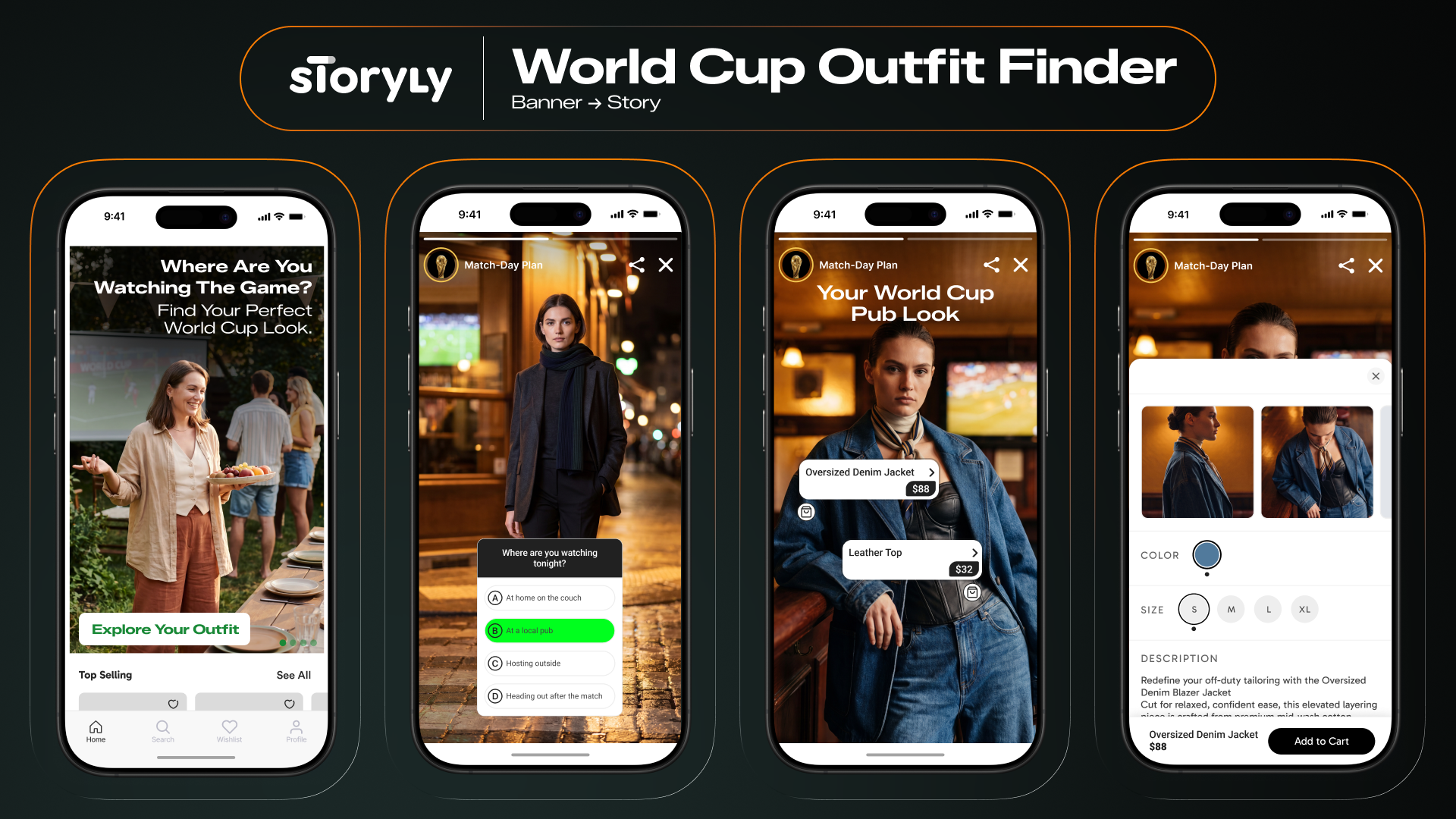
The entry point can be a Banner with a single question: "Where are you watching tonight?" It sits on the homepage before a major fixture. One tap opens a Story group with an interactive poll that presents the options: pub or bar, hosting at home, family viewing party, heading out after.
The fans tap their answers and from there, the subsequent stories in the group are each filtered by which answer the fan gave. Pub night fans move into a curated denim-and-layering edit with product tags on every piece. Home hosts get relaxed knitwear, serving accessories, and glassware. Family viewers see a comfortable family occasion angle. Each path is its own shop-the-look Story sequence, with product tags pulling directly from the catalogue and a CTA on the final slide. The best part is everything is configured entirely in the Storyly dashboard.
For brands that prefer a browse-first entry point over a question-first one, the same idea works with the Canvas widget. Four tiles by watch occasion, each opening into the relevant Story group. The Canvas creates lower friction to browse but does not do the sorting for the shopper. The Journey converts intent into product context automatically.
Best for: fashion, lifestyle, homeware, any multi-category retailer whose product covers occasion dressing, hosting, or home entertaining.
IDEA 11: Turn the Watch Party Occasion Into a Content Journey via Canvas
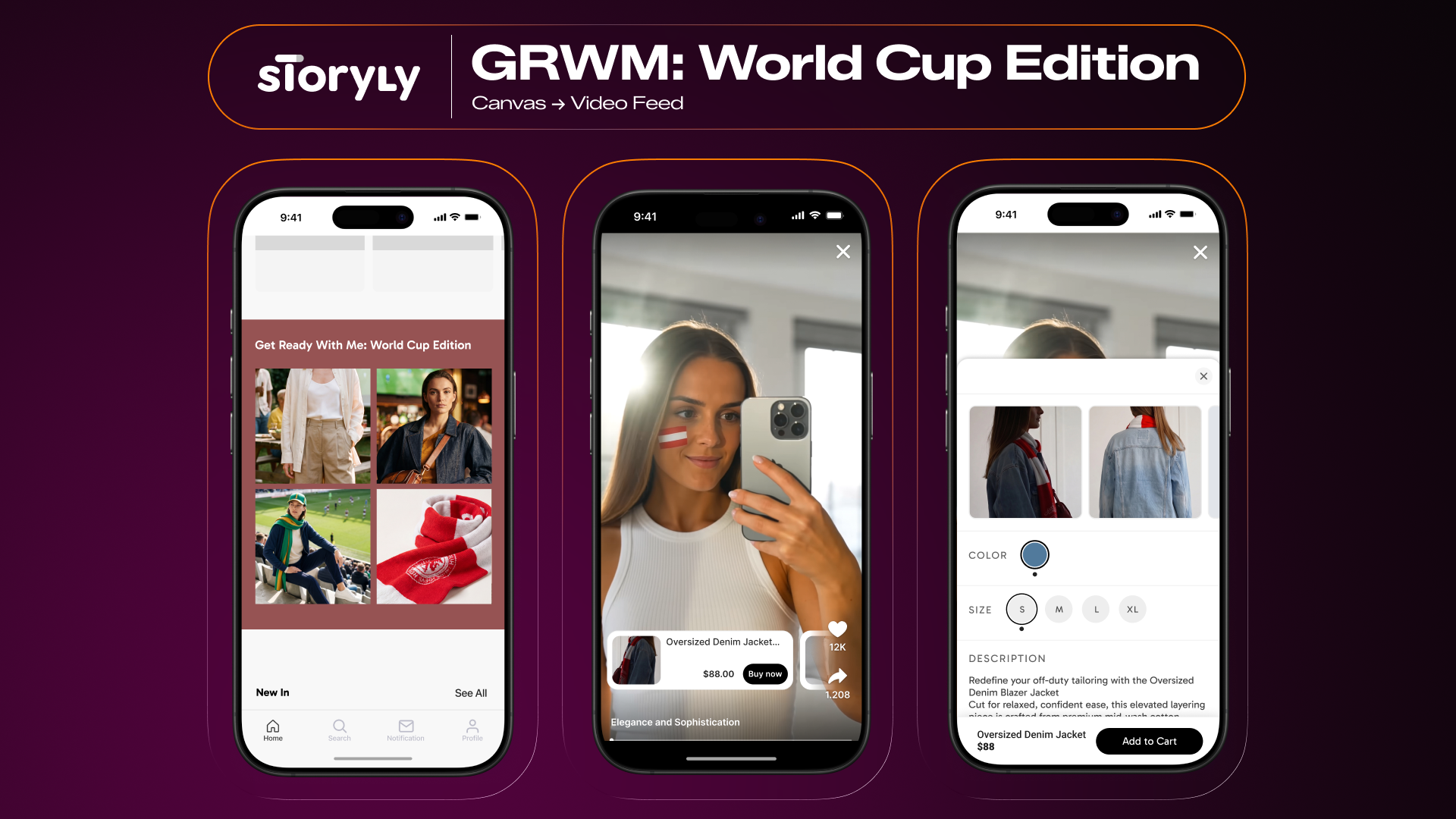
Most brands treat the "football fan" as a single segment. But how a fan watches the match shapes what they buy before it. The occasion is the brief. The product list follows from it.
A Canvas widget makes occasion selection the entry point to a curated content experience. For example, four tiles canvas on a single frame including watching alone, hosting friends, going out, outdoor setup. The fan sees it, taps their occasion, and lands in a dedicated story group built around exactly that context. The story group plays micro-influencer GRWM-style videos prepared for that specific setup. The game night version, the hosting version, the going-out version. Every outfit, snack, drink, and decoration that appears in the video is product-tagged. The fan taps what they want and lands on the PDP.
Or instead of a story group you can create a Video Feed which supports import directly from your brand’s TikTok and Instagram account, which also means the micro-influencer content you have been building on social channels come into your app without a separate production budget. For brands already working with creators, the tournament is a natural brief to occasion-specific GRWM content, and Canvas gives it a front-door in the app.
Best for: fashion, lifestyle, food and grocery, drink delivery, homeware, any brand with a micro-influencer programme already in place
IDEA 12: Give Your Athlete Partnership an In-App Experience
A lot of brands will enter the World Cup window with a famous footballer on their homepage. A jersey banner. A social post with the ambassador in campaign gear. That partnership asset is genuinely valuable, but as currently deployed, it is largely doing reach work, not conversion work. The fan sees the face and the brand logo. They do not get a specific reason to buy today.
The same partnership becomes something different inside Storyly. A Video Feed or Story group built around the athlete, training footage, behind-the-scenes content, styling moments in the actual products, turns the brand deal into an in-app experience. Every product that appears is tagged and shoppable. The fan watches a video of the footballer in the training kit. They tap. They land on the PDP. The partnership, which previously stopped at awareness, now has a direct commercial path inside the app.
The World Cup timing amplifies this specifically. If your brand ambassador is playing in the tournament, their every match is a moment to surface that content. A brand that already has a player's creative assets can schedule a Story group or Banner timed to the fixture. When that player scores or their team advances, the brand affinity is at its highest point. That is exactly when the in-app content should be live.
Best for: fashion, sportswear, food and drink delivery, any brand with an existing athlete sponsorship or ambassador relationship
The common thread
Every one of these ideas works because it puts the right content in front of the right person at the right moment inside the app they are already using. None of them require a FIFA partnership. None of them require a broadcast campaign. What they require is a clear read on which match moments create purchase intent for your audience and an in-app experience that is ready when those moments arrive.
The tournament runs for another five weeks. There are still more than a 100 matches left. That is more than a 100 windows where your app can either be somewhere worth opening or somewhere fans leave to go somewhere else.
If you want to see how these formats work inside a live app, explore Storyly's Widget Library or talk to the team.